Surprisingly it was amidst the confusion of war, that the Citizens’ Advice Bureau was born. Four days after Britain declared war on Germany in 1939, the CAB was setup to help people trace missing servicemen and re-house families bombed out of their homes. Now it is an important organization within our community that helps people navigate the minefield of government departments and the law.
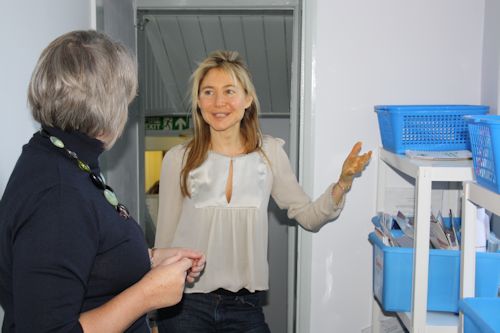
I am warmly greeted by Sarah Bellows who is the volunteer manager
As I arrive at the offices in All Saints Passage, Huntingdon I am warmly greeted by Sarah Bellows who is the volunteer manager.
Sarah is interviewing today for Gateway Assessors who are the first point of contact for clients. Their main task is to identify the nature of the client’s problem. ‘Often we can help people just by giving them some information. We can often empower people to help themselves but if their problem is more complicated then they will be passed to a fully trained experienced advisor. At this stage the Gateway advisor will make sure that the qualified advisor has a full brief of the situation before their meeting with the client so that they can prepare.’
Sarah introduces me to David and Daphne who are experienced volunteer advisors. David shows me into one of the interview rooms where he meets to talk privately with clients. Clients often call first but some just pop in as they are passing without an appointment. ‘Sometimes they are in such a muddle that you have to break their problems down logically and sort out one problem one week and sort out another problem a few days later.’
David and Daphne both have a very calm and measured manner. I immediately feel that either of them would be the person that I would want around in a crisis. They both remind me of the man that Rudyard Kipling describes in his famous poem, If…
David is softly spoken. “The two biggest issues that we deal with are debt and housing but you will see from the CAB website that we also cover issues concerning benefit, employment, family, consumer affairs, home and neighbourhood, Home and neighbourhood covers neighbour disputes – now that could be anything from an overhanging tree to noisy neighbours to your neighbour suddenly moving the boundary or blocking your drive.”
“There is already a lot of information available on the CAB website, www.adviceguide.org.uk but many of the people that we help don’t have access to the internet or their problem is more complicated than simply finding a contact number on the internet.”
David and Daphne work either one day or two half days a week. Sarah tells me, “We ask for 5-6 hours per week commitment from people as we invest so much in them with our comprehensive training scheme.” I was really impressed to discover that the training covers such breadth that you don’t need any previous qualifications to become an advisor. ‘It mainly consists of sessions and modules that you can take home and study over the first six weeks. That is then followed by supervised interviews…It’s challenging and fascinating.’
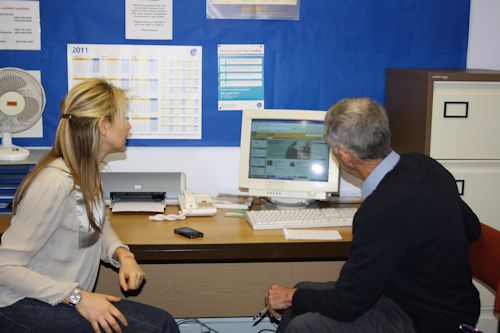
David shows me the CAB advisor website
David shows me the CAB advisor website.
“Our training teaches volunteers to look up the correct information even when you think that you know the answer to a question as the law and benefits are constantly changing.”
David explained that the training is not just about how to deal with the facts of the case. ‘Not just in dealing with the law but also coping with your own emotions when faced with other people’s problems. It doesn’t harden your heart …but the training and experience allows you to close the box after somebody has gone.’
“The most rewarding thing is when you see a client and they tell you that they have been worried about their problem for a long time and they’ve been having sleepless nights… You can see they have a huge weight on their shoulders… Then sometimes you can show them the way through and help them on their way or you are able to make a call and sort out the problem’.
Daphne continues, ‘They actually leave looking happier than when they arrived because they have spoken to someone. Sometimes you’ve done very little for them but they have offloaded the problem… and you know they’re going to sleep that night.’
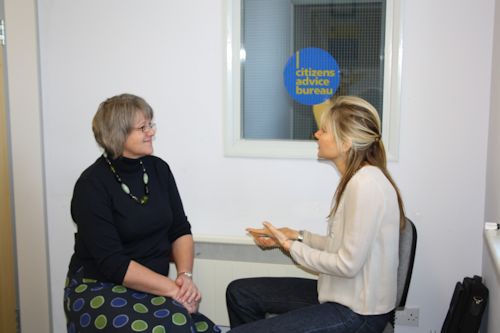
With volunteer manager Sarah Bellows
Sarah joins in, ‘It’s the difference that we make to people’s lives… that makes it incredibly rewarding… We can deal with everybody.’
‘Students often become involved as part of their law course as they can fulfill part of their module requirements and more importantly it gives them people skills. We also have gap year students wanting experience before they move onto university.’
Daphne became involved more than ten years ago as her children were growing up. ‘I wanted to be involved with something that was really interesting. I’ve certainly not regretted my decision. Sometimes we see a problem cropping up regularly and so we can flag it up and that can change government policy.’
David became involved 9 years ago before his retirement. ‘I was thinking that when I retire I wanted to do something useful… something that would be a service to somebody else. I just came along to the Huntingdon Office and said I wanted to be a volunteer.
Sarah would like to have enough volunteers so that the phones can be manned all day and so that they can run advice appointments throughout the day which is why she is currently interviewing. You can contact her on 01480 388900 or huntscab.org.uk
Facts about volunteering with the CAB
Excellent extensive training offered
5-6 hour per week weekly commitment
contact: Sarah Bellows 01480 388900 or huntscab.org.uk
If you are involved with a charity that recruits and trains volunteers and would like to be featured in this column then please email me on volunteers@rebeccadjanogly.com.
 rebeccadjanogly
Leave a comment