Today I am visiting a volunteer scheme that can transform the lives of our children. It is a volunteer scheme to give support to children from an early age. This support can have a profound effect on the child’s future life, often transforming a child’s self esteem and completely changing their school learning experience.
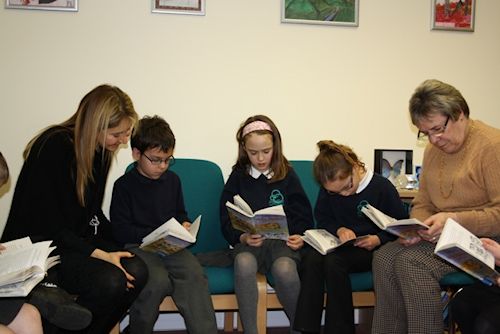 I am visiting Crosshall School in St Neots which regularly achieves the Ofsted ‘Outstanding’ award. Like many other schools in the area Crosshall offers one to one and small group reading classes staffed by volunteers who are trained on site by the school.
Even in 2012 it’s a disturbing fact that many children leave school without being able to read. Some figures put it as high as one in five leaving primary schools without adequate literacy skills. The impact of illiteracy on a child’s life is catastrophic. Providing help and support in reading at an early age means that a child is able to take advantage of the full range of education on offer throughout the rest of their school life. Without this help children who do fall behind on literacy are more likely to end up in trouble in other areas. In the worst cases a child who cannot read becomes an adult who cannot read, leading to tremendous difficulties in getting a job and navigating everyday life.
Children can grow up learning to hide the fact that they can’t read. These children don’t want to attend classes because they don’t want appear foolish in front of their peers.. This can really snowball and they turn into adults hiding the fact that they can’t read.
Catherine Harty has been involved as a helper at Crosshall for over fifteen years. She says, ‘I became involved because I love reading. When I first started I sat in on a few literacy lessons with the teacher and then I did some one to one sessions with a girl for half an hour once or twice a week at lunchtime. This really built up my confidence to help and the child’s confidence to read. Often one to ones are with younger children but in this case she was in Year 5 and she could read but it was stilted. Because she has to look at every word. She had to learn to let it flow.’
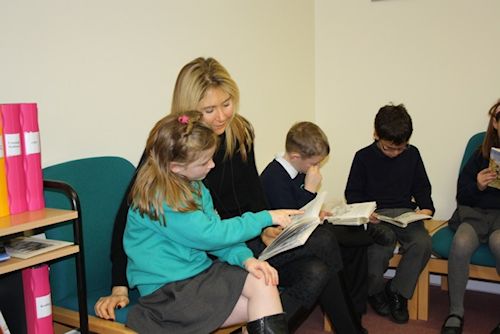 “I just feel passionately that if you can’t read you cant really do anything. You cant read a recipe book, if you get a new game then you can’t play the game as you can’t follow the instructions. It really is vital. If you can’t read the examination questions then you can’t possibly answer it.’
Many volunteers are content to remain helping children to read on a one to one basis as it can be very satisfying but once Catherine had built up her confidence she was happy to move onto group sessions.
Catherine introduced me to her group that day. I asked Polly (aged 7) about her lessons with Catherine and how they were different to her lessons with her teacher. “We get to learn new words that we don’t with our normal teacher. … We get to look words up in the giant dictionary. Last week we looked up monument, gutter and gargoyle.”
The small group are reading a book set in India. They start to read out loud in turn and this encourages discussion. Very soon they are learning about being absent minded, felling trees, dams and which senses are affected by being deaf, dumb or blind.
Catherine tells me that the problem for some of the better readers is that they don’t understand enough of the words that they are reading. Her group sessions help the children to think about the text and understand it better. “I had one particular girl in year 5 who’d read a particular Michael Morpugo book but by page 2 she couldn’t tell me what any word that I asked her about meant. By the time we had finished the book she saw it in a different way and said how much she’d enjoyed it.”
 I asked Hannah what she learns with Mrs Harty that she doesn’t learn in class. Hannah confidently replies, “We get to learn new words that we don’t with our normal teacher.’ Catherine regularly lets the children look up words in the dictionary so that they learn how to use it alone.
Through the small groups and one to one sessions the volunteers have more time to find out about other areas of the children’s life that might be affecting their work. ‘Recently I had a boy and he couldn’t do his homework. After I chatted with him it turned out that he had recently lost his grandfather and was very upset. He didn’t feel he could talk to anyone but once he had written down his feelings and chatted it over he was able to move forward with his work. ‘
Sometimes these things come out through the reading of the book. Often the children will tell me things as they see me as a friend rather than a teacher.
The aims of this volunteer scheme at Primary schools appear simple compared to other volunteer schemes I have visited– The results however are profound often transforming a child’s self esteem and entire experience of learning.
It’s difficult to imagine a more precious gift to give a child.
Across the country 20% of children leave primary school without adequate reading skills. (Source: Volunteer reading help)
- Crosshall would like to have extra volunteers to help with more one to one sessions.
- You can apply to Crosshall School to be a literacy volunteer by calling the deputy head, Anne Eardley on 01480 4759872. (You can also apply to be an Art volunteer or other areas that are of interest to you.)
- Alternatively you can call your local school as most schools will have a volunteer scheme.
- Naturally the school will need to CRB check anyone applying.
The names of the children have been changed.
 rebeccadjanogly
Leave a comment